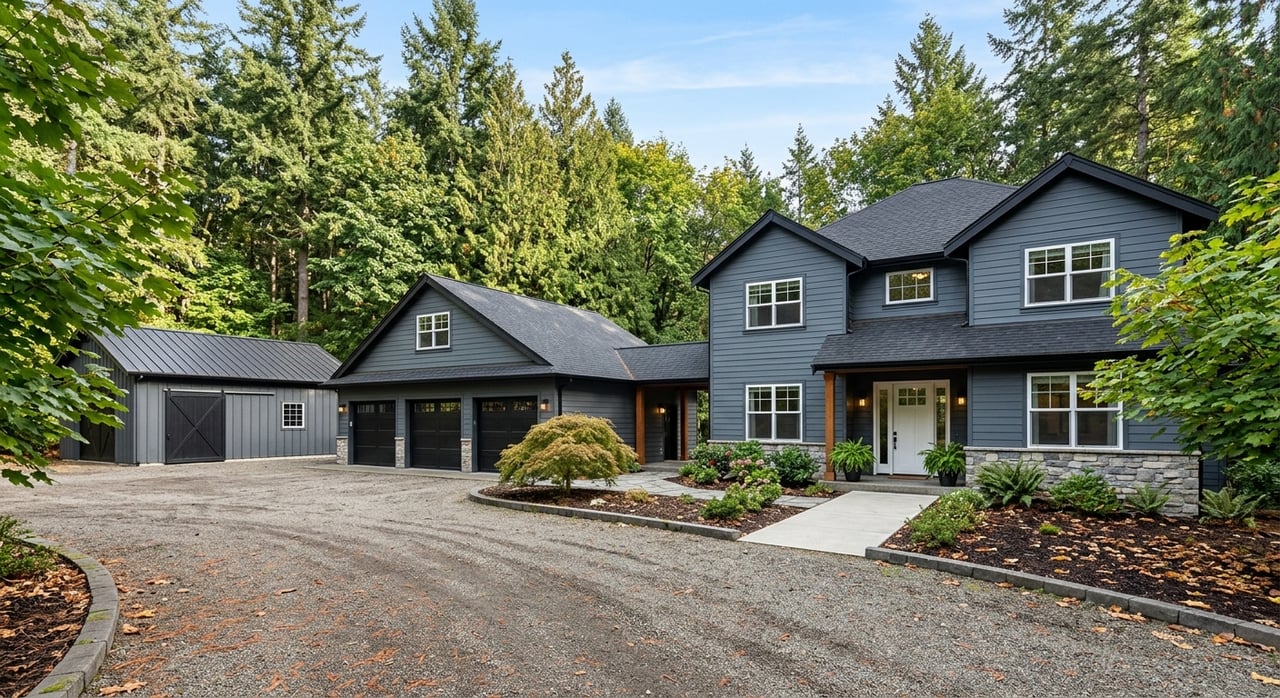
Buying an estate property in Stafford can feel exciting right up until you realize you are not just buying a house. You are also buying zoning rules, access rights, utility questions, and land-use limits that can affect how you use the property. If you want more space, privacy, or future flexibility, it pays to do deeper homework before you remove contingencies. Let’s dive in.
Why Stafford estate purchases are different
Stafford is not an incorporated city. It is an unincorporated Clackamas County hamlet, and the Stafford Hamlet serves in an advisory role to the Board of County Commissioners.
That matters because estate properties here are often more site-specific than a typical suburban home purchase. In many cases, you are evaluating the home itself plus acreage, zoning, utilities, documents of record, and whether future improvements are realistic.
Start with parcel-level research
Your first stop should usually be Clackamas County CMap. It can help you review jurisdiction, UGB status, services, natural hazards, and available documents tied to a parcel.
CMap is a powerful screening tool, but the county also says it is not survey-grade boundary data. If you have questions about exact property lines, you should treat those as survey issues rather than map-layer assumptions.
For recorded documents that can affect an estate purchase, the Clackamas County Recording Division is also important. This is where public real-property records may reveal easements, plats, restrictions, or access rights that could shape how you use the land.
Confirm zoning before planning changes
One of the biggest mistakes estate buyers make is assuming the land can support the improvements they want. In Stafford, that can include a shop, greenhouse, pool, guest use, extra garage space, or future expansion.
Clackamas County’s rural residential zoning rules include districts such as RA-1, RA-2, RR, RRFF-5, FF-10, and FU-10. Minimum lot sizes and dimensional standards vary by district, and uses not listed are prohibited.
That means the exact zoning on your parcel matters. Before you assume a plan will work, confirm the parcel designation on CMap and compare it with the county code.
What rural zoning can affect
Depending on the property, zoning can affect:
- Minimum lot size
- Setbacks from property lines
- Lot coverage limits in some districts
- Whether certain uses are permitted
- Whether future partitions, subdivisions, or changes may require land-use review
The county code does expressly allow many accessory uses common on estate properties, including garages, sheds, greenhouses, shops, storage buildings or rooms, pools, patios, pergolas, and similar improvements. Even so, allowed use does not eliminate the need to meet setbacks, septic constraints, and other permitting requirements.
Check ADU and second-dwelling rules carefully
If part of your estate-buying strategy includes multigenerational living, guest space, or flexible occupancy, do not rely on assumptions. Clackamas County notes that secondary-dwelling rules can change based on whether a parcel is inside the Portland Metro UGB or in an urban reserve.
The county’s recent rules indicate that rural ADUs can be allowed on rural residential sites outside an urban reserve. RV second dwellings may be allowed either inside the Portland Metro UGB or outside both a UGB and an urban reserve.
Because eligibility depends on the parcel’s exact status, this is one of the first questions to verify during due diligence. For many buyers, this issue alone can shape whether a property still fits the long-term plan.
Make sure the lot can actually be permitted
A beautiful estate parcel can still run into permit problems. According to Clackamas County’s building process requirements, a parcel generally needs to be a legally created lot, properly zoned for the use, accessible from a public or private street, served by sanitary sewer or an approved on-site sewage disposal system, have stormwater capacity, and have potable water on or accessible to the site.
This is especially important if you are buying for a remodel, replacement home, custom build, or major accessory structure. A property may look build-ready while still missing one of the county’s basic prerequisites.
Why accessory buildings need extra review
Estate buyers often focus on detached garages, barns, shops, or pole buildings. But the county says permits for garages or pole buildings are issued only as accessory structures to a primary use and only when the primary use already exists or is being applied for at the same time.
In other words, an outbuilding is not always a simple standalone project. The county may also review setbacks, zoning compliance, prior approvals, and septic implications before signing off.
Review septic records early
On Stafford acreage, septic due diligence should happen early, not after inspections are nearly done. Clackamas County says an approved septic site evaluation is the proof that a property meets septic requirements.
Just as important, home-site approval is not the same thing as septic approval. If no approved site evaluation is on record, the buyer or seller should apply for one.
Septic questions worth asking
Before you move forward, ask:
- Is there an approved septic site evaluation on file?
- Is the site evaluation still valid based on current conditions?
- Is there enough room for the home, planned accessory structures, and a repair area?
- Will additions, bathrooms, plumbing changes, or a shop trigger septic review?
The county says site evaluations do not expire, but they can become invalid if conditions change. Examples include added fill, grading, logging that damages soil structure, or installation of a well.
That is one reason estate properties deserve a coordinated review rather than a narrow home inspection alone.
Understand the well and water requirements
If the property uses a domestic well, water due diligence is just as important as septic. The Oregon Water Resources Department says archived well reports can show who owned the well, what construction was done, and how the well performed at the time.
The most useful details often include depth, casing size, flow rate, and water level. These records do not guarantee current performance, but they give you a strong factual starting point.
What sellers must provide in a well-water transfer
For a real estate transaction involving a domestic well, Oregon Health Authority requires the seller to test for:
- Arsenic
- Nitrate
- Total coliform bacteria
The seller must share the results with the buyer and send the RET form and results to OHA within 90 days. DEQ also notes that private or domestic wells are generally the homeowner’s responsibility and are not routinely tested unless there is a property transfer.
For estate buyers, this is not just a paperwork item. Water quality and well history can affect how comfortable and predictable ownership feels after closing.
Look closely at access and recorded rights
Access can be straightforward on one estate parcel and surprisingly complex on another. If a driveway crosses another parcel, if utilities depend on recorded rights, or if an older tract has unclear documentation, you want answers before closing.
That is why it helps to review public records through the county recording system and treat any unresolved boundary question as a survey issue. The county’s guidance around CMap makes this clear: map layers are useful, but they are not a substitute for boundary-level certainty.
Documents that can affect use
Depending on the parcel, key documents may include:
- Easements
- Plats
- Restrictions
- Access agreements
- Other recorded real-property documents
If your estate plans depend on fencing, a new driveway alignment, added structures, or expanded outdoor use, document review becomes even more important.
Pay attention to slopes and site conditions
Some of Stafford’s larger parcels may involve grading, retaining walls, drainage concerns, or steep terrain. Clackamas County notes on its erosion-control guidance that construction or development disturbing soil can require an EPSC permit.
The county also says residential site inspections may review excavation, grading, slopes, setbacks, and fill materials. Structural fills require geotechnical or civil-engineer certification.
Landslide risk is worth serious review
The county specifically notes that landslides are a real local hazard and that homeowner policies normally do not cover landslide losses. If a property has steep slopes, retaining walls, or major grading history, those features deserve focused review during your contingency period.
For buyers, this is less about being alarmed and more about being methodical. The goal is to understand site conditions before they become expensive surprises.
Know when a pre-application meeting may matter
Some estate properties come with plans for more than everyday ownership. If you are considering a partition, subdivision, conditional use, zone change, or relief from development standards, timing matters.
Clackamas County says pre-application conferences are required for several land-use actions that often come up on larger properties. Variances are the path for relief from standards such as setbacks.
This does not mean your plan will not work. It means your buying decision should reflect the actual county process, not a guess based on what seems possible from the street.
A smart due-diligence checklist
When you are evaluating an estate in Stafford, try to confirm these items before removing contingencies:
- Parcel zoning and dimensional standards
- UGB or urban reserve status
- Legally created lot status
- Access from a public or private street
- Recorded easements, plats, and restrictions
- Septic site evaluation and system records
- Well report details and transfer test results
- Slope, fill, grading, and erosion-control concerns
- Whether planned outbuildings or layout changes may trigger extra review
This kind of checklist can help you compare properties more clearly. It also gives you better leverage for negotiations if new facts surface during diligence.
Why coordination matters in Stafford
In a typical home purchase, your main questions may center on condition, price, and financing. In Stafford, estate purchases often require you to underwrite land-use feasibility, utility capacity, recorded rights, and site constraints at the same time.
That is why a coordinated review process matters. When inspections, records, and county-level research all point in the same direction, you can move forward with more confidence and fewer assumptions.
If you are considering an estate purchase in Stafford and want steady, data-driven guidance through property evaluation, zoning questions, and negotiation strategy, Eleete Real Estate can help you approach the process with clarity.
FAQs
What should you verify before buying an estate in Stafford?
- You should verify zoning, UGB or urban reserve status, access, recorded easements, septic records, well information, and any slope or grading concerns tied to the parcel.
How do you check zoning for a Stafford estate property?
- A good first step is reviewing the parcel in Clackamas County CMap and then confirming the zoning rules against the county’s rural residential zoning code.
Why is septic due diligence important for Stafford acreage?
- Clackamas County says an approved septic site evaluation is the proof that a property meets septic requirements, and site conditions or future improvements can affect whether prior approvals still work.
What well tests are required in an Oregon property transfer?
- For a domestic well in a real estate transaction, the seller must test for arsenic, nitrate, and total coliform bacteria, share the results with the buyer, and submit the RET form and results to OHA within 90 days.
Can you add an ADU or second dwelling on a Stafford estate?
- It depends on the parcel’s rural zoning and whether the site is inside the Portland Metro UGB or an urban reserve, so the property’s exact status should be confirmed before you rely on that plan.
Are outbuildings simple to add on a Stafford estate parcel?
- Not always. Even if rural districts allow garages, sheds, shops, or similar structures, the county may still review setbacks, zoning compliance, primary-use status, and septic-related impacts before issuing permits.